If you’ve ever walked through a chemical processing plant, a mining operation’s slurry line, or a food and beverage factory’s corrosion-resistant equipment bay, you’ll notice one unspoken constant: every component that moves, transfers, or holds material is fighting two battles at once—wear from friction, and degradation from chemical exposure. As a wear-resistant parts supplier, I get asked this question more often than any other: How do these parts actually hold up when chemicals are in the mix? It’s not a simple yes or no answer. It depends on the part’s material, how the chemical interacts with that material, and how well the part is engineered to handle both forces at the same time. I’ve spent 12 years on the floor talking to plant operators, field service technicians, and process engineers, and I can tell you: the worst mistakes happen when someone assumes a wear-resistant part designed for abrasion will automatically survive chemicals, or a corrosion-resistant part will stand up to heavy wear. Let’s break this down with real examples, not just textbook charts. Wear Resistant Parts
First, let’s get one core point straight: wear and chemical degradation don’t work in isolation. Most people think of wear as just abrasive particles scraping away a surface, and chemical attack as a reaction that dissolves or eats through material. But in almost every industrial application, the two combine to create a faster, more destructive force. I remember a conversation with a mining plant engineer three years ago. They were using standard high-chrome alloy wear plates for their flotation circuit pumps, which move slurry mixed with dilute sulfuric acid used to separate copper ore. Those plates lasted 6 weeks on average, which sounded fine until we tested a ceramic-infused variant we’d developed in partnership with a local materials lab. That ceramic plate lasted 18 weeks. The difference wasn’t just the ceramic—it was how the material handled the combined force. The high-chrome alloy’s smooth, hard surface was great for stopping abrasive rock particles, but the dilute sulfuric acid seeped into tiny micro-cracks in the alloy, weakened the bonds between the metal grains, and made it easier for those rocks to scrape material away. The ceramic part, on the other hand, had a matrix of alumina ceramic particles bonded with a specialized rubber and polymer blend. The alumina resisted abrasion better than high-chrome, and the polymer blend was formulated to not react with dilute sulfuric acid—so there was no weakening of the grain structure. That’s the key: engineered materials that address both factors at once, not just one.
Let’s talk about common material types, because that’s where most specifiers go wrong. Carbon steel is the cheapest, but it’s terrible for chemicals—even mild chemicals like water with a pH of 5 will corrode it, and once it corrodes, it wears out in weeks. We see this all the time in wastewater treatment plants, where carbon steel augers for moving sludge rust through in 2 to 3 months, even with paint. Stainless steel is better, but not all stainless. 304 stainless works for many mild chemicals, like low-concentration sodium hydroxide, but if you put it in a solution with chloride ions (super common in brine used for water treatment, or in food processing’s salt brine for pickle production), it will get pitting corrosion. That pitting creates tiny holes that abrasive particles get stuck in, and suddenly the part wears through in half the expected time. I’ve seen 304 stainless screw conveyors in a pickle plant that failed in 4 months, while a custom wear part we made with 316 stainless (the chloride-resistant grade) lined with a tungsten carbide overlay lasted 20 months. The carbide overlay added the wear resistance, the 316 stainless added the chemical resistance, and together they avoided that pitting that kills so many stainless parts.
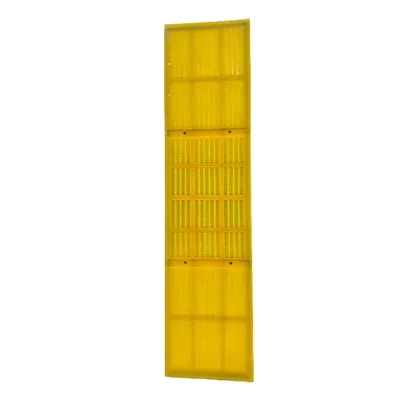
Then there are the polymer-based wear-resistant parts, like polyurethane and rubber. These are great for applications where chemicals are present but temperatures aren’t extreme. I worked with a food processor that was moving citrus pulp through a series of pumps and screens. The pulp has citric acid, which is mild, and the original parts were cast iron with a paint coating. The paint peeled off after a few weeks, the iron rusted, and the pulp became contaminated with metal flakes. We switched them to polyurethane wear screens and pump impellers. Polyurethane resists citric acid far better than paint, and its elastic property absorbs the impact of the pulp particles, so it wears slowly. The only catch? If the same processor decided to use a more concentrated, higher-temperature citric acid solution (like for citrus concentrate production), the polyurethane would break down—chemicals will make polymers swell, degrade their molecular bonds, and turn them soft and sticky. I’ve seen that happen when a juice plant tried to use the same polyurethane impeller for their concentrate line; it was falling apart in 2 months, so we switched to a filled PTFE impeller, which can handle higher acid concentrations and temperatures. PTFE is often overlooked for wear parts because it’s slippery, but when you fill it with glass or carbon fibers, you boost its wear resistance enough for pump applications, and it holds up to even strong acids like hydrochloric acid for short-term exposure.
Another big factor is pH and chemical concentration. Most parts fail not because of strong acids or bases, but because of inconsistent chemical levels. A lot of plants have process streams where pH fluctuates—one week it’s slightly acidic, the next it’s slightly caustic, and sometimes both in the same day. We did a test last year for a chemical manufacturer that makes fertilizers. Their conveyor belts carry granular fertilizer that has ammonium nitrate, which is slightly acidic, but occasionally they have spills of sodium hydroxide for cleaning, making the material temporarily caustic. They were using standard nylon wear strips for the conveyor guides. Nylon resists ammonium nitrate well, but when exposed to even small amounts of sodium hydroxide, it hydrolyzes—its molecular bonds break, it becomes brittle, and it cracks under the constant friction of the conveyor belt. We switched them to a modified polyamide wear strip that has UV stabilizers and chemical resistance additives formulated for both acidic and alkaline fertilizer materials. That strip has lasted 10 months so far, while their old nylon strips needed replacement every 6 weeks. The additive was the difference; it didn’t just add chemical resistance on paper, it changed how the polymer reacted when exposed to alternating pH levels, preventing hydrolysis.
Let’s not forget about the role of surface treatment. You can have the right base material, but a bad surface treatment will still make it fail. I’ve seen a lot of specifiers choose parts with a “wear-resistant coating” without asking what the coating is, or how it bonds to the base material. For example, chromium plating is a common coating for wear parts, but it’s terrible for most acids. It will flake off if exposed to even dilute sulfuric acid, leaving the base metal underneath to corrode and wear. We had a customer in the pulp and paper industry who was using chromium-plated doctor blades to scrape black liquor from paper machines. The black liquor has sulfides and caustic soda, and the chromium plating would flake off in 3 months, leaving the blade to rust and leave streaks on the paper. We switched them to a diamond-like carbon (DLC) coating that’s formulated to resist caustic solutions, bonded to a stainless steel base. That blade is still in operation 18 months later, with no flaking or wear-related streaks. The key here is that surface treatments need to be matched to the specific chemical environment, not just the wear load. A coating that works for a neutral, high-wear mining application will not work for a caustic paper mill.
Now, let’s talk about what we’ve learned as a supplier over the years, because this is the practical stuff that doesn’t make textbooks. The number one mistake plant operators make is copying a solution from another application without testing. For example, a mining company told me they used a ceramic wear part for their iron ore slurry, so they bought the same part for their copper ore slurry that uses flotation chemicals. The copper part failed in 2 months, while the iron ore part lasted a year. Why? The copper flotation uses xanthates, organic chemicals that absorb into the ceramic’s polymer matrix over time, making it brittle. We had to adjust the polymer matrix to be resistant to xanthates to make the ceramic part work for copper. Another mistake is under-sizing or over-designing parts. Over-designing means spending 3x more on a part than needed, while under-sizing means replacing it every month, which is more expensive in downtime and replacement costs. We do free, on-site assessments for this exact reason—we go to the plant, watch the process, test the chemical levels, see the wear pattern, and recommend a part that’s engineered for their specific combination of wear and chemicals, not a generic “wear-resistant part.”
I also want to address a common myth: “chemical-resistant parts don’t need wear resistance, and vice versa.” That’s only true if you never have both. 90% of industrial wear applications with chemicals are both. I had a customer in the water treatment sector a few years ago who thought their carbon-lined valves were enough for their chlorine solution. Chlorine is highly corrosive, but the carbon lining is resistant to it, right? Wrong. The valve was opening and closing against its seat every few minutes, and the constant friction between the carbon seat and metal stem wore a tiny groove in the carbon. Chlorine seeped into that groove, corroded the metal stem, and the valve seized up in 3 months. We replaced the carbon seat with a tungsten carbide seat that’s both chlorine-resistant and wear-resistant, and matched it with a Hastelloy stem (another corrosion-resistant alloy). That valve has been working for 3 years with no issues. It’s not that the carbon was bad—it was just missing the wear component that the application needed.
So, what does this all mean if you’re shopping for wear-resistant parts that work in chemical environments? First, don’t rely on material names alone. Ask for specific chemical resistance data for the exact solutions in your application, including their concentration, temperature, and exposure time. A part that works for 20% hydrochloric acid at 70°F might disintegrate at 50% hydrochloric acid at 150°F. Second, look for parts that are engineered for combined wear and chemical forces, not just one or the other. That might mean a composite material, a coated part, or a custom alloy, depending on your needs. Third, work with a supplier that has real field experience, not just lab data. A lot of suppliers will give you a material compatibility chart, but the best ones can tell you how that material performed in a similar application, how it held up to fluctuating chemical levels, and what the actual service life was, not just the estimated one.
At the end of the day, the performance of wear-resistant parts in chemicals isn’t about picking the hardest or most expensive material. It’s about matching the material’s properties to the unique stresses of your specific application. It’s the difference between a part that lasts 6 weeks and causes unplanned downtime that costs you thousands of dollars, and a part that lasts years, keeps your process running smoothly, and avoids contamination or safety issues.
If you’re dealing with an application where wear and chemicals are working together to destroy parts, and you’re tired of replacing parts every few months with no improvement, I’d encourage you to reach out to discuss your specific needs. We can walk through your process, review your current part failures, and recommend a solution tailored to your operations, no generic one-size-fits-all products.
Polyurethane Screen References:
- Burak, S., et al. (2021). Combined effects of abrasion and corrosion on material degradation in industrial slurry systems. Wear, 486-487, 204098.
- Davis, J.R. (2000). Wear-resistant materials: alloys, ceramics, and composites. ASM International.
- Fontana, M.G. (1986). Corrosion engineering (2nd ed.). McGraw-Hill Book Company.
- Hamed, G.R., & Radcliffe, S.J. (1983). Rubber reinforcement. Elsevier Science Publishers.
- Kranzmann, A., et al. (2018). Selection of wear-resistant materials for applications in corrosive environments. Tribology International, 128, 246-255.
Yangzhou Yaye Wire Mesh Manufacturing Co., Ltd.
As one of the most professional wear resistant parts manufacturers in China, we have world-leading production equipment and strong manufacturing capabilities. Please feel free to wholesale cheap wear resistant parts in stock here from our factory. Also, free sample is available.
Address: No. 1 Jiangjia Road, High-tech Industrial Park, Jiangdu District, Yangzhou City, Jiangsu Province
E-mail: 13952515577@163.com
WebSite: https://www.yayescreen.com/
